
How to Protect Yourself Against Unscrupulous Contractors: A Legal & Forensic Guide
By Matthew Furlong
*What homeowners and community associations need to know. Prepared by Matthew Furlong of Först Consulting Group, LLC for the Fairfax Bar Association — Real Estate Practice Section.*
Hiring a contractor is one of the largest financial decisions a homeowner makes, and Virginia law gives you real tools to protect yourself—if you know where to look before you sign. This guide distills what every homeowner, attorney, and association board should understand about contractor licensing, enforceable contracts, credential verification, and the statutes that govern construction disputes and fraud in the Commonwealth. It reflects the material Matthew Furlong presented to the Fairfax Bar Association’s Real Estate Practice Section, drawn from more than 25 years in construction and forensic consulting.
*The following is construction business information, not legal advice. Först Consulting Group is not a law firm. Consult a licensed attorney for advice on your specific situation.*
Virginia Contractor Licensing Laws & Requirements

Virginia regulates who may perform construction work and at what value, through several layers of licensing that can apply to a single project: a Virginia business license (registered with the State Corporation Commission), a Virginia contractor or trades license (issued by the Department of Professional and Occupational Regulation, or DPOR), local business and contractor licenses, individual trades licenses for specialties like electrical and plumbing, and—for pre-1978 homes—EPA Renovation, Repair and Painting (RRP) certification.
The most important distinction for a homeowner is the contractor’s **license class**, which § 54.1-1100 of the Code of Virginia defines by the value of a single contract or project:
– **Class C** — a single contract or project over $1,000 but less than $30,000
– **Class B** — a single contract or project of $30,000 or more, but less than $150,000
– **Class A** — a single contract or project of $150,000 or more, with no upper limit
Each class also carries a 12-month aggregate limit (Class C under $250,000; Class B $250,000 to under $1 million; Class A $1 million or more), and certain trades such as water-well and landscape-irrigation contracting are governed by separate thresholds under § 54.1-1103. Beyond class, every license carries a **classification or specialty**—for example, RBC (Residential Building Contractor) or CBC (Commercial Building Contractor)—that defines the type of work permitted. A contractor with the right class but the wrong specialty is not properly licensed for your work. Most projects also require a separate building permit from your local jurisdiction.
Essential Terms Every Residential Construction Contract Must Include
Construction contracts are typically structured as lump sum (also called stipulated sum or fixed price), cost-plus, or unit price. Whatever the structure, four terms are indispensable to any enforceable contract: the **parties** bound by it, a clear description of the **project**, the **time of performance** (start and estimated completion), and the **cost** (total price and payment schedule).
Virginia regulation goes further for residential work. Under **18VAC50-22-260(B.8)**, anyone engaged in residential contracting must use a legible written contract clearly specifying the terms and conditions of the work, signed by both the consumer and the licensee before work begins or payment is accepted. Under **18VAC50-22-260(B.9)**, that contract must contain, at minimum: when work begins and the estimated completion date; a cost statement appropriate to the contract type (for a standard project, the total cost; for cost-plus, the fee or percentage and a not-to-exceed cap; for time-and-materials, a fixed labor price inclusive of overhead and materials); the amounts and schedule of progress payments, including the specific down-payment amount; a listing of specified materials and work requested by the consumer; a plain-language clause addressing events beyond the contractor’s control; a statement that the contractor will comply with local permit, inspection, and zoning requirements; disclosure of cancellation rights; a signed acknowledgment that the consumer received and read the DPOR statement of protection; the contractor’s name, address, license number, class, and specialty; a statement that any change to cost, materials, work, or completion date must be in writing and signed by all parties; and notice of the Virginia Contractor Transaction Recovery Fund. Related provisions require the contractor to deliver a fully executed copy of the contract before work begins and to keep the contract and all change orders for five years.
If a contract is missing these elements, that is itself a red flag worth pausing over before you sign.
How to Verify a Contractor’s Credentials in Virginia
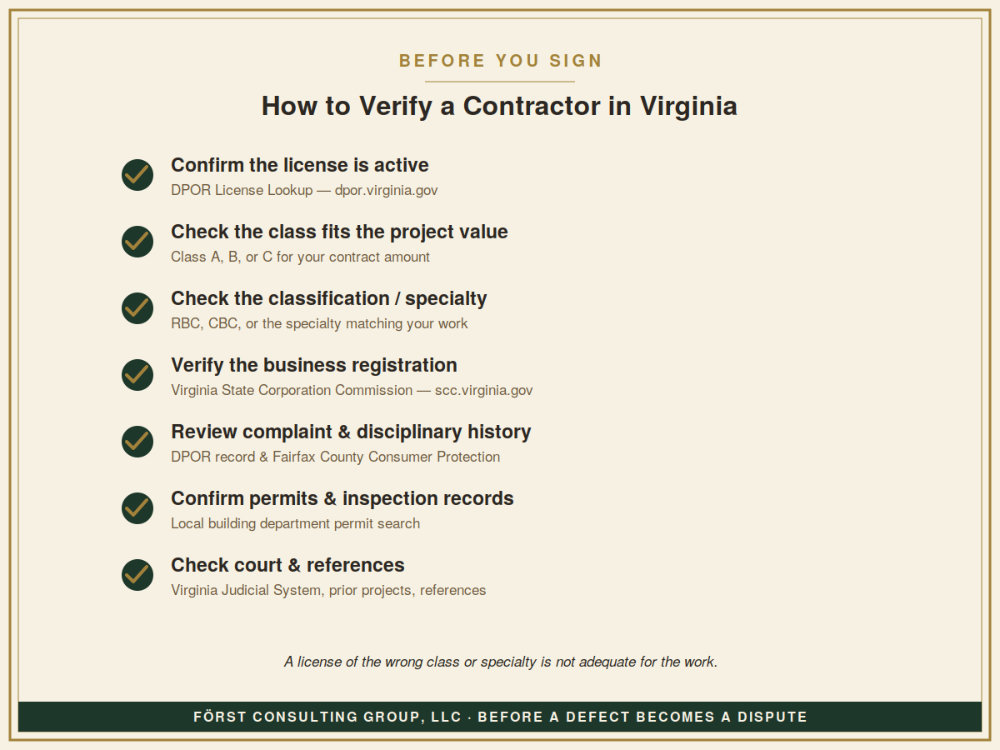
Verification takes only a few minutes and can save you from a costly mistake. Before signing, confirm the contractor through the State Corporation Commission (business registration) and the DPOR License Lookup, which shows license status, class, specialty, and any disciplinary history. In Fairfax County, you can also check the local BPOL business license (703-222-8234, option 4), Class C licensing (703-324-1937), building permit records through the county’s permit search, and complaint history through Fairfax County Consumer Protection. Case history is searchable through the Virginia Judicial System, and real estate records through the county’s iCare portal. Rounding it out with a web search, a drive-by of prior projects, and a call to references gives you a full picture. Confirm four things in particular: that the license is active, that the business identity matches, that the class is sufficient for your project’s value, and that the specialty fits the work.
How Först Consulting Group Helps
When something about a contractor’s work doesn’t sit right, an independent forensic assessment turns suspicion into documented fact. Först Consulting Group investigates construction defects, reviews contracts before they’re signed, audits invoices for overbilling, and provides expert witness testimony for homeowners, attorneys, community associations, and insurers throughout Northern Virginia, Maryland, and Washington, D.C. Our findings are measured against published standards—the applicable building codes, manufacturer requirements, and the statutes above—so they hold up whether a dispute settles or goes to trial.
*Reference: Virginia Board for Contractors Regulations (18VAC50-22) and the Code of Virginia, Title 54.1, Chapter 11. The complete regulations are published by DPOR and are available at [dpor.virginia.gov](https://www.dpor.virginia.gov/sites/default/files/boards/Contractors/A501-27REGS.pdf). Thresholds and requirements reflect the September 1, 2025 edition and are subject to change; verify against the official regulation before relying on them.*
*Disclaimer: This guide offers construction business information only and does not constitute legal, accounting, or tax advice. Först Consulting Group is not a law firm and cannot provide legal advice. Readers are strongly encouraged to seek experienced professional advice in the review of contracts or other legal or financial activities where liability or compliance issues are of concern.*