
Why Nobody Builds Like They Used To: The Skills Gap Behind Today’s Construction Defects
By Matthew Furlong, Principal, Först Consulting Group, LLC. Drawn from more than 25 years in construction and forensic consulting across Northern Virginia, Maryland, and Washington, D.C.
There’s a moment in *The Sopranos* that has stuck with me for years. Tony is standing in an old church, looking up at the stonework, and he gets to talking about the men who built it: the masons and carpenters who raised structures meant to stand for centuries, who took pride in work they knew would outlast them. His lament, delivered in his own blunt way, is that those men are gone, and that today we can barely manage the small stuff. The craftsmen who once built cathedrals have given way to people who can’t reliably do a simple job right.
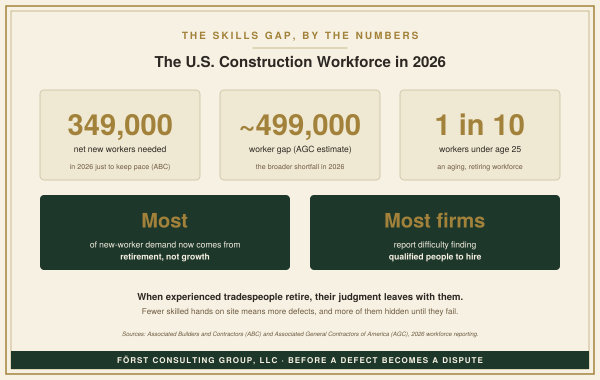
The shortage is real, and the numbers are not subtle.
This isn’t nostalgia. The 2026 figures are stark. The Associated Builders and Contractors estimates the industry needs roughly 349,000 net new workers this year just to keep pace, and the Associated General Contractors has put the gap closer to 499,000. The large majority of construction firms report trouble finding qualified people to hire. Only about one in ten construction workers is under 25, which tells you the workforce is aging out far faster than it’s being replaced.
Here’s the part that matters most for anyone who owns a building: a majority of that new-worker demand now comes from *retirement*. The most experienced tradespeople are leaving the trade. These are the people who learned under a mentor and spent decades absorbing the thousand small judgments that separate sound work from work that merely looks finished. When they go, the knowledge goes with them. You can hire a replacement far faster than you can replace what that person knew.
How we got here.
I was lucky. In middle school and high school I had drafting, auto shop, and wood shop, and by tenth grade I was in hands-on vocational programs off campus. That used to be normal. A student who wasn’t headed for a four-year degree could graduate already knowing how to read a drawing, swing a hammer, wire a circuit, or frame a wall, and could step into an apprenticeship and build a real career from it.
Over the last few decades, we quietly dismantled that. Shop classes vanished from school budgets. Vocational tracks were treated as the lesser path, and “college for everyone” became the default expectation, often at the cost of real debt and with no guarantee of a job at the end. The trades, meanwhile, were left to a shrinking network of apprenticeship programs that simply can’t train people fast enough to replace the generation retiring out. The good news, and there is some, is that a number of school systems are now bringing shop and career-and-technical education back, a tacit admission that cutting it was a mistake.
I’ll stay in my lane on the politics of how that happened. Plenty of people across the spectrum share the blame, and plenty now agree it was an error. What I can speak to, with authority, is the result: a generation of builders who were never taught the fundamentals, working under deadline pressure, on increasingly complex buildings, with fewer and fewer experienced hands on site to catch their mistakes. That is not a recipe for durable construction. It’s a recipe for exactly the defects I’m hired to document.
What the skills gap looks like from where I stand.
When I’m called to a property, I’m not looking at abstractions. I’m looking at the physical evidence of what happens when work outruns skill. The patterns repeat, and most trace back to someone who either didn’t know the right way or wasn’t supervised by anyone who did:
**Structural members cut where they should never be cut.** Joists and trusses notched or drilled through to make room for a duct or a pipe, quietly compromising the load path because nobody on site understood it.
**Electrical work that violates basic code.** Splices made where they can’t be, junction boxes buried in walls with no access, exterior-rated connectors used indoors. These are shortcuts taken by someone who never learned why the rule existed.
**Moisture trapped inside the building.** This one is getting worse. As energy codes push us toward tighter, more heavily insulated envelopes, a single air-sealing mistake or a poorly designed HVAC system no longer just wastes energy. It traps humidity inside the wall and the ceiling, and mold follows. Builders in humid climates are facing a rising wave of these claims, and nearly every one I’ve examined comes down to a skill or design failure a well-trained crew would have avoided.
**Finish work that fails early.** Tile, stucco, and siding installed without the flashing, the drainage, or the simple patience the material requires. It’s the small stuff Tony was talking about, writ across an entire house.
None of these are exotic. That’s the point. They’re failures of fundamentals, and fundamentals are exactly what we stopped teaching.
Don’t count on the inspection to catch it.
Here is the assumption that gets homeowners in the most trouble: *the work passed the county inspection, so it must be fine.* I wish that were true. It isn’t, and understanding why is one of the most valuable things a property owner can learn.
The same labor shortage that thinned the ranks of skilled tradespeople has thinned the ranks of experienced building inspectors, for the same reasons. A municipal inspection is a brief, largely visual check against a checklist, often performed by someone carrying a heavy caseload and working under the same time pressure as everyone else in the industry. Inspectors cannot see inside finished assemblies, they are not there to catch everything, and, bluntly, the erosion of hands-on training affects the person reading the work just as it affects the person doing it. I have seen plainly deficient work pass inspection more times than I can count.
And here is the part that truly matters: **when an inspection misses a defect, you generally have no recourse against the jurisdiction.** Courts across the country have consistently held that building inspectors and the municipalities they work for are shielded by governmental (sovereign) immunity from liability for negligent inspections, on the reasoning that the duty to inspect runs to the public at large and not to the individual homeowner. In practice, when defective work that was “approved” later fails, the owner is told it is a civil matter to pursue against the builder, and the inspecting authority steps away. You are left holding the bag for work a government office signed off on, with no claim against that office.
So treat a passed inspection as the low bar it is, a minimum and not a guarantee, and never as a substitute for independent, qualified eyes of your own.
Why an independent expert is now a necessity, not a luxury.
For a routine project this may be overkill. But if you are building a custom home, or undertaking a complex renovation or addition, the economics have changed. The thin margin of skilled supervision that used to be built into the process, the experienced foreman, the seasoned inspector, the tradesperson who’d done it a thousand times, can no longer be assumed. You have to supply it yourself.
That is precisely the role I play for owners: an independent construction subject-matter expert engaged **from contract negotiation through final completion**, working as a liaison between the owner and the general contractor. In practice that means:
**At the contract stage**, reviewing the agreement and scope before anyone signs, so the terms, allowances, change-order process, and responsibilities actually protect you.
**During construction**, monitoring the work at the critical milestones, verifying precision fit and finish, confirming strict adherence to the state and local building codes by the general contractor, and inspecting concealed work (framing, electrical, plumbing, insulation) before the drywall closes it in forever.
**Throughout**, serving as your knowledgeable voice in the room, so you are not negotiating technical questions with your own contractor alone, and raising issues early, while they are still cheap to fix.
**At completion**, confirming the finished product is synonymous with the design you paid for, not a near-enough approximation.
The goal is simple: catch the problem while it is still a few hours of a carpenter’s time, not after it has become a failed wall, a mold remediation, or a lawsuit. An independent expert during construction costs a fraction of what the same defect costs to prove and remediate afterward.
What I do, and why it still comes down to the standard.
The craftsmen in Tony’s church are gone, and we are not getting that world back quickly. But a building still has to obey the same physics it always did, and the standards for doing it right are still written down: the applicable building code, the manufacturer’s installation instructions, the recognized performance guidelines. My work, whether I’m monitoring a build in progress or documenting one that has already failed, is to hold the work to those standards and explain the difference in terms a homeowner, an adjuster, a mediator, or a jury can follow.
Before a defect becomes a dispute, and when it already has, that is the service Först Consulting Group provides for homeowners, contractors, community associations, attorneys, and insurers throughout Northern Virginia, Maryland, and Washington, D.C.
Further Reading.
For readers who want the underlying data and independent reporting behind this piece:
– Associated Builders and Contractors — annual construction workforce shortage analysis (the 349,000-worker 2026 figure): [abc.org]
– Associated General Contractors of America — workforce survey and data: [agc.org]
– “Amid the Emerging AI Economy, We Need a Skilled Trades Pipeline in High School” — The 74: [the74million.org]
– “Shop Class Resurgence: Can It Help Resolve the Skilled Labor Shortage?” — Pro Builder / NAHB: [probuilder.com]
– “The Value of Vocational Education in U.S. High Schools” — Education Next: [educationnext.org]
– On governmental immunity for inspection: “Construction Officials & Municipalities: Immune from Liability for Construction Defects?”: [princetoninfo.com]
—
*This article reflects the professional observations and opinions of the author and is offered as general construction and industry commentary. It is not legal advice, and the discussion of governmental immunity is a general description of a legal doctrine, not a statement about any specific jurisdiction or matter; consult a licensed attorney for advice on your situation. Först Consulting Group is not a law firm. Workforce figures cited reflect 2026 reporting from the Associated Builders and Contractors and the Associated General Contractors of America.*